


Voltage Drop DC Formulas and Processes
Voltage Drop Calculations Using NEC 2026 Chapter 9, Table 8
Purpose:
NEC Chapter 9, Table 8 is used to find conductor properties, including circular mil area and direct-current resistance. For voltage drop work, the most important columns are:
Conductor size
Area in circular mils
Direct-current resistance at 75°C
Resistance in ohms per 1000 feet, if working in feet
Resistance in ohms per 1000 meters, if working in meters
The Table 8 values are DC resistance values at 75°C. This makes Table 8 especially useful for DC voltage drop and for simple resistance-based voltage drop calculations. For more precise AC voltage drop, especially on large conductors or long runs, NEC Chapter 9, Table 9 is normally used because AC circuits also include reactance and impedance.
1. What Voltage Drop Means
Voltage drop is the voltage lost in the conductor because every conductor has resistance.
As current flows through the conductor, some voltage is used up pushing current through that resistance.
Basic idea: E=I×R
Where:
E = voltage drop, in volts
I = current, in amperes
R = conductor resistance, in ohms
The longer the run, the more resistance.
The smaller the wire, the more resistance.
The more current flowing, the more voltage drop.
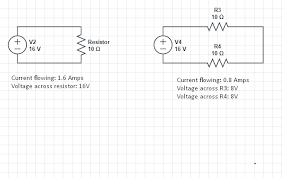
Another way to consider it is using DC circuit analysis. You know that to find the total resistance of resistors wired in series you simply add the value of the resistors. The length of wire is a resistance and think of each foot of wire as a separate resistor. Each foot is “wired” in series with each other; therefore, the total resistance of the conductor is based on the resistance per foot times the number of feet.
Important NEC Design Guideline
The NEC commonly uses voltage drop as a design recommendation, not usually as a mandatory rule. The common NEC informational-note design target is:
Not more than 3% voltage drop on a branch circuit
Not more than 5% total voltage drop for feeder plus branch circuit
The only enforceable NEC voltage-drop limits are special-case rules. The normal 3% branch-circuit and 5% feeder-plus-branch values are design recommendations in Informational Notes, not general enforceable NEC requirements. NEC 90.5(C) says Informational Notes are informational only and are not enforceable as Code requirements.
Enforceable NEC voltage-drop requirements
NEC rule | Where it applies | Requirement |
NEC 647.4(D) | Technical power systems for sensitive electronic equipment | Voltage drop on any branch circuit must not exceed 1.5%. Combined feeder and branch-circuit voltage drop must not exceed 2.5%. |
NEC 647.4(E) | Receptacles supplied by Article 647 technical power systems | Receptacle branch-circuit voltage drop is more restrictive; commonly stated as 1% maximum. |
NEC 695.7 | Fire pump circuits | Voltage at the fire pump controller line terminals must not drop more than 15% during motor starting; voltage at the fire pump motor terminals must not drop more than 5% while operating at 115% of motor full-load current. |
Information Needed Before Starting A Voltage Drop Caclulation
Before calculating voltage drop, gather the following:
System voltage: Example: 24 VDC, 120 V, 208 V, 240 V, 480 V
Load current: Use the actual load current when known.
Conductor material: Copper or aluminum.
Conductor size: Example: 8 AWG, 4 AWG, 1/0 AWG, 500 kcmil.
One-way circuit length: Use the one-way distance from source to load.
Measurement system: Feet or meters.
Circuit type: DC two-wire, single-phase, or three-phase.
Using Table 8 Directly: Resistance Method
This is the most straightforward method.
For a DC two-wire circuit or single-phase two-wire circuit:
VD= (2×I×D×R) / 1000
Where:
VD = voltage drop, in volts
2 = outgoing and returning conductor path
I = current, in amperes
D = one-way distance, in meters or in feet
R = Table 8 conductor resistance in ohms per 1000 meters
Use meters if the distance is measured in metric or feet if the distance is measure in imperial units.
Very Important Rule: Do Not Mix Units
If the distance is in feet, use ohms per 1000 feet. If the distance is in meters, use ohms per 1000 meters
Example: DC Voltage Drop Using Table 8, Imperial Distance
Problem
A 120 VDC circuit supplies a 20-amp load. The load is 300 feet from the source. The conductor is 4 AWG uncoated copper.
Find the voltage drop.
Step 1: Find 4 AWG copper in Table 8, Chapter 9 of the NEC
From Table 8:
4 AWG copper = 41,740 circular mils
4 AWG uncoated copper resistance = approximately 0.308 ohms per 1000 feet
Step 2: Use the imperial voltage drop formula
VD= (2×I×D×R) / 1000
VD=( 2 x 20 x 300 x 0.308) / 1000
VD=3.696V
Step 3: Find percent voltage drop
%VD= (The voltage drop value you just found/ divided by the system voltage) x 100
%VD= (3.696 /120) x 100= 3.08%
The voltage drop is approximately: 3.7V The percentage voltage drop is approximately 3.1%
Example: DC Voltage Drop Using Table 8, Metric Distance
Problem
A 120 VDC circuit supplies a 20-amp load. The load is 90 meters from the source. The conductor is 4 AWG uncoated copper.
Find the voltage drop.
Step 1: Find the metric resistance value
From Table 8, 4 AWG uncoated copper has a resistance of approximately: 1.010 Ω/km
Step 2: Use the voltage drop formula VD=(2×I×D×R) / 1000
VD= (2×20×90×1.010) / 1000= 3.636 Volts
VD=3.636V
Step 3: Find percent voltage drop
%VD= (Voltage drop you just found / the system voltage) x 100
(3.636 / 120) x 100= 3.03
%VD=3.03%
Answer
The voltage drop is approximately 3.64V. The percent voltage drop is approximately 3.0%
You can find an approximate three phase voltage drop using the same formula but with one change. Instead of using 2 in the formula, use 1.732. This will give you only an approximate line to neutral voltage drop. To find the actual line to neutral and line to line voltage drop on a three phase AC system, use the AC voltage drop formula that follow this explanation of DC voltage drop formulas.
NOTE: Most Journeyman Licensing Exams use the approximate method and table 8 above for all voltage drop calculations including AC. If the question reads what the actual line to is neutral or the actual line to line voltage drop then you would need to use Table 9 to determine that with the AC voltage drop calculation. Otherwise, just use the approximate by using table 8 and the DC method described above substituting the 2 for 1.732.
Calculating Voltage Drop using A Constant Value for Resistance instead of Direct Resistance.
Another popular method of calculating voltage drop is to use a K value for resistance instead of direct resistance above. This is popular because it gives the same answers as the direct method and the formula has a mnemonic that helps electrician remember the formula.
What the K Value Means
The K value is a resistance constant for conductor material.
It is commonly used in this voltage drop formula:
VD= (2 x K x D x I) / CM
This can also be written: 2KDI / CM= VD I recommend you write this formula down for future reference under table 8 in your NEC for future reference.
A handy mnemonic is to remember: Two Kiddies ( 2KDI) by a Cute Mom ( CM) named Victor and David. (VD)
Where:
VD = voltage drop
K = conductor material resistance constant
D = one-way distance
I = current in amperes
CM = conductor area in circular mils
For uncoated copper at 75°C, the common K value is approximately 12.9 if the distance is measured in imperial units and 42.3 if the distance is measured in metric units.
For aluminum at 75°C, the common K value is approximately 21.2 if the distance is measured in imperial units and 69.5 if the distance is measured in metric units.
You don’t have to memorize the K values though if you have Table 8 of the NEC.
How to Find K Using Table 8
The formula is K = The resistance of 1000 units of 1000 kcmil wire x 1000. I recommend you write this formula down under table 8 in your NEC for reference in the future.
By units we mean either feet or meter depending on how your distance measurement is made, either in feet or meters.
To find the K value for the material you are using in conjunction with the type of measure your distance is measured in use the 1000 kcmil row of Table 8, Chapter 9 of the NEC. I advise apprentices to highlight this entire row in table 8 so that it stands out and they can remember where to find the K value.
So if you look at the 1000 kcmil row on Table 8 and move across the table to the right to
Ohm/ km for Uncoated Copper you will see a value of 0.0423 now multiple this by 1000 for a result of 42.3. The K factor for uncoated copper when the distance is measured in metric units is 42.3.
Now slide one more column over to Ohm/ kFT and you find a value of 0.0129. Now multiple this by 1000 for a result of 12.9. The K factor for uncoated copper when the distance is measured in feet is 12.9.
You can continue this process for Aluminum and find the K values for Aluminum if the distance is measured in meters or if the distance is measured in feet.
IMPORTANT NOTE:
The only difference in how we calculate distances in metric or imperial is the K value we use. There is no conversion between feet to meters or vice versa. The NEC lists all values in both Metric, listed first and Imperial. The NEC uses hard and soft conversions based on the circumstances and it specifically states in Article 90.9(D) that conversion is not needed by us and use of the values listed in the NEC meet compliance with the NEC requirements.
ANOTHER IMPORTANT NOTE:
Uncoated copper in Table 8 is not a reference to insulation or not insulated. Coated copper as the term is used here references the copper wire that is used in motor windings, transformers, and corrosive environments were a clear coating of insulation is applied to the copper. Electricians rarely encounter this coated copper wire. Unless a situation or question specifically refers to Coated Copper, always use the uncoated copper column for voltage drop calculations. This uncoated copper is the type of copper you are used to dealing with. The type that can be bare or may be inside THHN, THWN or any number of insulations. It is not coated; it is either insulated or bare and that does not make a difference for resistance on Table 8.
You can also use this formula to determine the approximate voltage drop on a three-phase balance system by substituting the 2 for 1.732. This will be an approximate value. If an actual and accurate voltage drop for an Alternating current three phase circuit, then Table 9 and the AC voltage drop formula will be used. Most journeyman licensing tests use the approximate and Table 8 method for their questions for both DC and AC questions.
Examples:
Example: An approximate voltage DC voltage drop using feet for distance measurements.
A 120 VDC load draws 20 amps. The conductor is 4 AWG uncoated copper. The one-way distance is 300 feet. Find the voltage drop using the K method.
Step 1. Find the circular mils for the wire that is being used on Table 8.
4 AWG= 41,740 CM
Step 2. Find the K value for resistance from Table 8 using the 1000 kcmil row and the ohms per thousand feet column for copper and then multiply that by 1000.
K= 0.0129 x 1000= 12.9
Step 3. Work through the voltage drop formula of (2KDI)/CM= VD
2 x 12.9 x 300 x 20= 154,800
154,800/ 41,740= 3.71
Voltage drop is 3.71 Volts
The percentage of voltage drop is: (VD/ System voltage) x 100= % of Voltage Drop
3.71/ 120= .0309 x 100= 3.09 %
Example: An approximate three phase AC voltage drop using meters for distance values
Problem
A 208 V, three phase, load of 59 A is fed with THNN aluminum conductors size 3 AWG. The load is located 110 meters from the source. What is the approximate voltage drop, line to line, in this circuit?
Step 1: Find circular mil area on Table 8
3 AWG=52, 620 CM
Step 2. Determine the K value for resistance using the 1000 kcmil row and the Aluminum Ohms per 1000 Meters column of Table 8 and then multiply that number by 1000.
K= 0.0695 x 1000= 69.5
Step 3: Use the formula for approximate three phase AC voltage drop using Table 8 and DC values.
VD Three Phase Approximate from Table 8= (1.732 X K x D x I) / CM
1.732 x 69.5 x 110 x 59= 781,227.26
781,227.26 / 52,620= 14.85 Volts
The approximate voltage drop line to line is 14.85 Volts
The percentage of the voltage drop= (The voltage drop / The system Voltage) x 100
14.85 / 208= .0714 x 100= 7.14%
We can use the same formula with a slight adjustment using algebra concepts to find the minimum conductor size needed to keep a voltage drop within a required voltage drop percentage.
For example: What size XHHW Aluminum conductor will be needed to ensure the voltage drop on a 1500 VDC, Solar PV system remains less than 2%? The system has a load of 210 amperes. The DC combiner box is located 240 feet away from the inverter.
The voltage drop K formula is (2KDI) / CM = VD
If we switch the VD and CM we get the formula: (2KDI) / VD= CM
This is what we are looking for in this situation. What circular mill size wire do we need to keep voltage drop at 2% or less. So we are looking for a CM and we know the VD.
VD= 2% of 1500 Volts which is the system voltage.
Step 1. Determine how many volts 2% is of 1500 volts but multiplying (1500 x 2) / 100
1500 x 2 = 3000 / 100= 30
2% of 1500 Volts is 30 volts.
Our voltage drop, (VD) must be 30 volts or lower
Step 2. Determine the K value using the 1000 kcmil row and the Aluminum Ohms per 1000 feet column of Table 8 and then multiply that by 1000.
K= 0.0212 x 1000= 21.2
Step 3. Work the formula ( 2 x K X D x I) / VD = CM
2 x 21.2 x 240 x 210 = 2,136,960
2,136,960 / 30= 71, 232 CM
Step 4. Now use Table 8 and find a conductor that has at least 71,232 Circular Mils.
A 2 AWG has 66,360 CM and A 1 AWG has 83,690 CM.
The minimum sized conductor that we can use to maintain a voltage drop of 2% or less is a 1 AWG aluminum.
“Table 8 gives us two important things: conductor area and conductor resistance. If we use the resistance directly, we multiply the current, distance, and resistance. If we use the K method, we use the conductor’s circular mil area and a material constant. Both methods are based on the same idea: current flowing through conductor resistance causes voltage drop.”
“The 1000 kcmil row is the easiest way to find K because 1000 kcmil equals 1,000,000 circular mils. When we multiply the 1000 kcmil resistance by 1,000, we get the K value. For copper, 0.0129 ohms per 1000 feet becomes K = 12.9. For aluminum, 0.0212 ohms per 1000 feet becomes K = 21.2 if our distance is measured in feet.
“Always remember: feet go with ohms per 1000 feet. Meters go with ohms per 1000 meters. Keep your units straight, and the voltage drop calculation becomes much easier.”
Most licensing exams use the approximate voltage drop for AC circuits using Table 8 Resistance values and the K method for determining AC voltage drop as demonstrated above. Please remember this is an approximate voltage drop and does not take into consideration reactance, impedance and power factor. In real life situations where an accurate and actual voltage drop is needed for an AC system you will need to use Table 9 and the AC voltage drop formula which I will discuss in a another article on AC voltage drop.
Ted " Smitty " Smith


Comments